Tag: writing

  • Urgent Murders Important

    Urgent Murders Important

    Urgent (adj) compelling or requiring immediate action or attention.
    Important (adj) of great significance or consequence.

    The most important concept that should be taught to young leaders, corporate execs, and anybody that wants to accomplish anything of significance in their lives is to finish tasks in the order of their importance. The problem is that many people confuse the urgent with the important.

    Dwight D. Eisenhower said, “What is important is seldom urgent and what is urgent is seldom important.”

    Urgent things demand our attention immediately, but they may not be important in the overall scheme of our lives. That’s why the really important things, the things that will add value to our lives over the long term can get put off indefinitely; because they are not screaming for our attention.

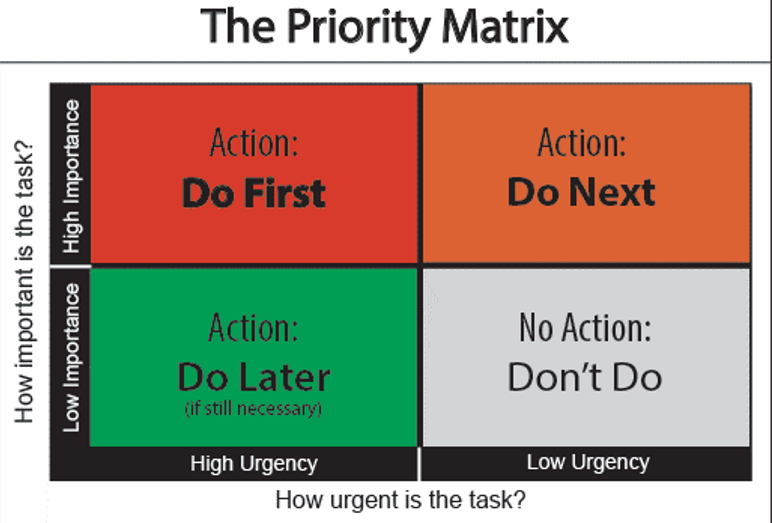
    When making your to-do list, prioritize your tasks according to this standard:

    1. Urgent and important
    2. Non-urgent but important
    3. Urgent and non-important
    4. Non-urgent and non-important

    Completing your urgent and important tasks first is a no-brainer.

    The hardest thing, will be deciding whether to handle the number 2 or the number 3 items first. When something urgent comes hurtling towards you, arms flailing, it will command you to take care of it right now Now NOW! It takes discipline, but before addressing this incredibly urgent and demanding task, ask yourself “is this important?” A question I ask myself is “will this matter five years from now?

    If this urgent task that requires your immediate attention is something that can be delegated, rescheduled, or even ignored without causing you long-term harm, then ditch it. Take care of what’s important first.

    Then the things that are neither urgent nor important, you work on those when you have absolutely nothing else to do. Watching television goes in that category.

    What are some urgent tasks that seem to always pop up in your life?
  • The Past: A Great Place to Visit But I Wouldn’t Want to Live There

    The Past: A Great Place to Visit But I Wouldn’t Want to Live There

    I am a firm believer in our ability to change our circumstances in life. Prayer, goal setting, dream building, meditation, focused effort; These are all tools that allow us to determine through our own volition how we live our lives. But, no amount of prayer, goal setting, dream building, meditation or focused effort will allow you to change your past.

    We cannot determine our past. It’s too late. It’s happened. But we can determine our future. Starting right this moment, you can make a decision that will affect your future. But trying to live in the past will always hurt you.

    Maybe your past was awesome. Glory day after glory day. Each day of your present that you spend reminiscing, doesn’t add any additional glory to those days. If you have one entire year of awesomeness, but ten years later, the only thing you have to talk about is that past awesome year… Well, suddenly you’ll realize that the past wasn’t so awesome now that it’s been spread out over eleven years (I’m pretty sure it can be explained by the physics property of diffusion).

    Or perhaps your past was terrible. Constantly dwelling on it out of a sense of guilt will sabotage your present happiness and keep you from recovering from past tragedies.

    While you are living your today, which direction are your focusing on? Each day, our thoughts and works are either being invested in our future, or wasted on our past. Each day, concentrate on adding to your future value and worth; because you cannot add to your past value and worth.

    Now, I am not advocating memory wipes for everyone. The past does serve a purpose. Your past experiences teach you. It will give you one of two lessons: Do something different next time. Or do more of the same. But you must do.

    Live your today,
    using your past as a guide,
    to benefit your future.

  • Never Change, Stay Insane

    Never Change, Stay Insane

    Thomas Watson said, “If you want to succeed, double your failure rate.” We as humans do stuff. When we do stuff, sometimes we succeed and sometimes we fail. But no matter the outcome, we can always benefit from it. When we succeed at the task at hand we receive whatever benefit we hoped to get from that task: the contract, the sale, the date. When we fail at it, we have an opportunity to learn.

    Notice though, that I didn’t say we learn from failure, just that we have the opportunity to learn from it. There is nothing inherently great about failing.

    But when you have a healthy attitude about failing, it is not heartbreaking, it does not lower your own sense of worth, it does not devalue you as a person. As long as you are trying and failing, you are growing. And as long as you are growing, you are becoming greater. You are adding value to yourself as a person.

    When you fail at something, and life is trying to teach you a lesson, just remember this: A lesson will be repeated until it is learned. Fail once, maybe you can blame it on chance. Fail a second time, maybe the odds just weren’t with you. Fail one thousand consecutive times, you may want to consider changing something. Always keep an eye out for the lesson so that life doesn’t have to keep beating you with that stick to get your attention.

    Many people know about the tens of thousands of failed experiments that Thomas Edison went through in the process of inventing the electric light bulb. And, many people have heard about history’s possibly most positive comment when asked if he was dejected or depressed: “I have not failed. I’ve just found 10,000 ways that won’t work.” Yes, he kept trying. But the key was that he kept trying different things.

    Albert Einstein defined insanity as “doing the same thing over and over again and expecting different results.”

    So while persistence is admirable, without the willingness to learn and change, we are not exhibiting determination so much as lunacy.