
Tag: success

  • Halftime Report: How Are Your New Year’s Resolutions Going?

    Halftime Report: How Are Your New Year’s Resolutions Going?

    It’s July 1st! The perfect time to take an assessment of how we are doing on our New Year’s resolutions. Did you make any at all? If you did, you have already separated yourself from 25% of the population. Do you still remember what they were? If so, you are probably ahead of another 25% of the population. If you can tell me today what your New Year’s resolution was for 2018, then you are ahead of the average person in the US even if you haven’t even started on them yet.

    Before you pat yourself on the back too hard though, keep in mind:

    1. 51% is still a failing grade, and
    2. I just made up those numbers anyway

    A lot of authors and speakers talk about looking forward towards your goals (I’m one of them). But we should also take some time to reflect on our past and on our journey. We can often get caught up in the busy-ness of being busy. When that happens we can get off-track and realize that our habits are no longer moving us towards our goal.

    A personal trainer friend of mine became so focused on exercise that he neglected proper rest and recovery time. He would push himself to the point of injury (sprain, pulled muscle, stress fracture, etc…), then not allow proper time to heal before pushing himself again. He broke out of that habit when he realized that he had lost sight of his goal in the pursuit of the process. His goal was not to exercise, his goal was good physical health.

    The human creature is designed to achieve, the brain is designed as a goal-seeking mechanism, and we are happiest when we are in the process of fulfilling a worthwhile purpose. But it is easy to forget the “Why” of our activities when we get too focused on the “How.”

    So I’m calling a brief time-out for everyone at the halfway point of this year to ask: How are your New Year’s resolutions going?

    If you never made one, make one now.
    If you haven’t started, then start now.
    If you’ve kicked at it on occasion, make a definite commitment of time and energy towards achieving it now.
    If you are that rare person that has been striving towards it non-stop since January 1st, then take a day off and ask yourself a few questions:

    • How is my progress? Am I seeing results or am I just doing a lot of activity that is not actually accomplishing anything?
    • How is my motivation? Am I still visualizing my goal on a daily basis? Is my daily activity drudgery or is it inspiration for me?
    • How is my life? Am I neglecting an important part of my life? My business, my family, my health?

    Whatever your vision, goals and habit that you have or have not incorporated into your life prior to today, pause for a moment. Take some time to reflect. Take some time to replenish. Take some time to refocus. Do not lose sight of your vision amidst your daily activity; whether that is activity relevant to your goal or activity that is irrelevant to your goal.

    So, one more time: How are your New Year’s resolutions going?
  • Failure Is Not An Option, It Is A Necessity

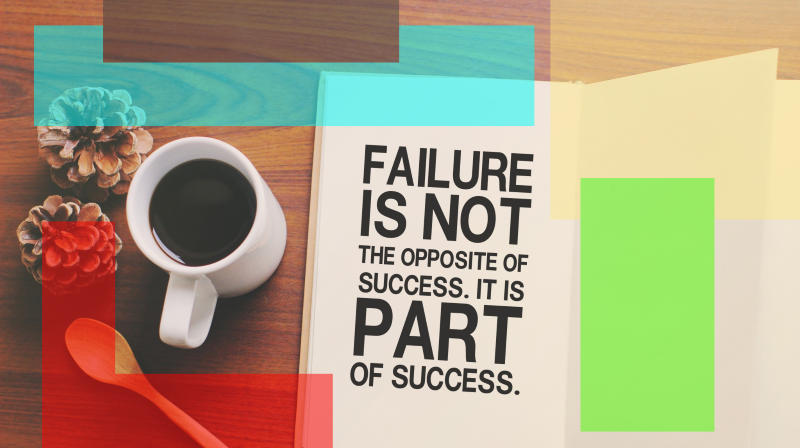
    Failure Is Not An Option, It Is A Necessity

    Everybody fails from time to time. Anyone that has never failed at something has probably never accomplished anything worthwhile. Nearly every mental or physical activity you have ever performed in your life, you failed at it the first time you tried it (except for those things performed automatically by your nervous system). But somehow, when we reach a certain age we become self-conscious and start to view failure as a bad thing.

    Failure is not a bad thing, our reaction to the failure is what is important. If we allow embarrassment to overshadow our desire to achieve, then a few early failures will derail whatever you are attempting; whether it is algebra, skiing, or asking a girl to the prom. Nobody likes failing, falling or rejection. But you will live a happier more fulfilled life if you retake that quiz, go back up that slope, and ask another girl out. As long as we maintain the idea that a single failure is a normal part of life, we just view them the same way we view bumps in the road. When you hit a bump, you keep driving. You don’t get out of your car and yell at the bump in the road, and berate yourself for hitting the bump, then blame the bump on your future problems.

    Winston Churchill said, “Success is the ability to go from one failure to another with no loss of enthusiasm.” Understand this, the opposite of success is not failure, the opposite of success is quitting.

    Quitting also becomes a habit. And when we develop a habit of quitting when things get hard, eventually we stop trying altogether. So we try fewer and fewer new things. We stay in familiar territory, we stay comfortable, we stop growing and we start stagnating. “A man can fail many times, but he isn’t a failure till he gives up.”

    Try to fail at something this week.

  • Trick Question: Quality or Quantity?

    Trick Question: Quality or Quantity?

    In high school I wrote a report on Stephen King. Two actually, for my junior and senior year English classes. (Well, one really, and a later “revised edition”). Whether you like or dislike Stephen King as a writer, you cannot deny that he is successful. During my research I read about King’s work habit in an interview. He would write for 8 hours every day, 362 days a year (he took off only three days). On average, he would produce ten pages of work every day, producing a book and a half a year. Take a look at his biography, to see the list of awards, movies, and novels with his name attached.

    One more quick story. An art professor teaching a ceramics class divided the class into two groups. Group A, would have their grade based on the total number of pottery pieces they completed during the semester. Group B, would have their grade based on only a single final masterpiece that they had the entire semester to complete. Group A jumped in, churning out ceramics as fast as possible. Group B, planned, studied, strategized then finally towards the end of the semester, built their prize work. And at the end of the semester all the best pieces in the class came out of Group A.

    Even though Group A had no grade incentive to actually produce anything of quality.

    Quality comes out of quantity. As Ernest Hemmingway once said, “The first draft of anything is (excrement).” The first group of students developed the most skill and the best quality work because they spent the most time working. Stephen King, especially early in his career probably wrote a lot of work that he threw away in disgust, but he kept going consistently and persistently. (And fortunately his wife, Tabitha, pulled the first dozen or so pages of Carrie out of his wastebasket).

    Here is my three step process to producing quality work.

    1. Start. Do not wait for inspiration or motivation. Roll up your sleeves and work.
    2. Keep Going.
    3. Go to Step 2.

    Then here are two sub-steps to help guide the process, but I wouldn’t add them in until at least 21 days have passed and you have developed a work habit of some sort. Also, these are always in addition to Step 2 and Step 3, never instead of them.

    4. Review your work. Make sure you are progressing in the direction you want.
    5. Seek Advice. From qualified people.

    That’s my five step process to producing quality work. I know I like to keep things simple, but is that too simple? Would you add another step?